University of Applied Sciences Northwestern Switzerland Academy of Art and Design, IDCE, Basel Fall 2025, Critical Theory Wednesday 13:00—16:30 Bérénice Serra [she/her] ↗ berenice.serra@fhnw.ch
With the rise of Web 2.0, online public spaces have been reshaped by user-generated content, placing amateur images and digital expressions at the center of social interaction. These contributions have not only transformed communication but also provided an inexhaustible resource for designers, artists, and cultural producers, fostering post-digital practices of appropriation, reuse, and reinterpretation. At the same time, digital traces have become integral to machine learning systems, fueling databases for surveillance, autonomous technologies, and algorithmic culture more broadly. This dual use, by humans and machines, has sparked new analytical practices in civil society and the arts, where digital communication is increasingly understood as both social exchange and data flow. This course examines this paradigm shift in the production, circulation, and reception of online content. The course will invite students to critically engage with the digital transformation of communication, culture, and design, while reflecting on their own practices within these environments. Along the way, we will explore emerging perspectives such as the ecology of user-generated content, post-mortem avatars, permacomputing, and interspecies media, which broaden the scope of how communication technologies intersect with social, cultural, and ecological concerns. Ultimately, students will develop tools to understand and question how communication is shaped, mediated, and contested in contemporary digital ecologies. Expected participation Research, articulate, and present to the class a field of research of your choice along with its literature. In your presentation, clearly explain how your own area of expertise could interact with or contribute to this field.
September, 17 01 — Self study (reading and exploration)
*no room available due to CoCreate workshops* Explore websites that could be usefull to find interesting topics. ↗ PAD - You’re welcome to add notes about topics you’d like to discuss in class, or share additional websites and resources with the group. Websites _WIRED : https://www.wired.com/ _Panic World = podcast + Garbage Day newsletter (same person) : https://pod.link/1740187810 _Neural Magazine : https://neural.it/ _Digicult Magazine : https://digicult.it/ _Rhizome : https://rhizome.org/ _Monoskop Wiki : https://monoskop.org/Monoskop _Makery website + Newsletter : https://www.makery.info/en/ _Arte TV "tracks" : https://www.arte.tv/de/videos/119473-014-A/tracks/ _Furtherfield : https://www.furtherfield.org/ _Real Life Magazine : https://reallifemag.com/ _E-flux Journal : https://www.e-flux.com/journal/ _Data & Society : https://datasociety.net/ _Are.na (collaborative research platform): https://www.are.na/
September, 24 02 — Ecology of User-Generated Contents (studiokino)
↗ PAD for today Review syllabus and introduction (15 min) Lecture: The aesthetics of copyright (40 min) Screening: “A Truly Shared Love”, Émilie Brout & Maxime Marion, 2021 Reading: Roland Barthes, “The Death of the Author”, Aspen, 1967. Open discussion about today's topic Artworks _ Elaine Stutervant - Stutervant, 1924-2014. LINK _ Sherrie Levine - After Walker Evans, 1981. LINK _ Richard Prince - New Portraits, 2014. LINK _ Ilan Manouach - Tintin Akei Kongo, 2015. LINK _ Cory Arcangel - Working on My novel, 2014. LINK _ Joao Rocha - Kim Jong Il looking at things, 2012. LINK _ Céline Manz - The appropriator’s user guide, 2013. LINK _ Gwenola Wagon, Dance Party in Iraq, 2013. LINK _ Paolo Cirio - Capture, 2020. LINK _ Aram Bartholl - 15 seconds of fame, 2010. LINK _ Caroline Delieutraz - Two Visions, 2012. LINK _ John Rafman - Nine eyes, 2008-to-today. LINK _ Eva & Franco Mattes, Befnoed, 2013. LINK _ Evan Roth - Public Domain Donor Card, 2008. LINK _ Documentary - Good Copy Bad Copy, 2013. LINK Writings _ Kenneth Goldsmith (2011) “Uncreative Writing. Managing Language in the Digital Age”. Read: Introduction + Chapter 5. Why Appropriation? _ Eric Schrijver (2018) “Copy this book. An Artist’s Guide to Copyright”, Onomatopee. _ Omar Kholeif (2018) “Goodbye World! Looking at Art in the Digital Age”, Sternberg Press. _ Roland Barthes (1967), “The Death of the Author”, Aspen. writing.upenn.edu/~taransky/Barthes.pdf _ Lawrence Lessig (2004) “Free Culture: How Big Media Uses Technology and the Law to Lock Down Culture and Control Creativity”, Penguin Press. _ Nadia Walravens (2002) “The Concept of Originality and Contemporary Art”, in Dear Images. Art, Copyright and Culture, Ridinghourse. _ Marcus Boon (2010) “In Praise of Copying”, Harvard University Press. _ André Gunther (2015) "L'image Partagée", Éditions Textuel.
October, 1st 03 — Post-mortem Avatars (D5.06)
↗ PAD for today Review of previous class + debate (20 min) Lecture: From daemons to Afterlife bots (45 min) Screening: "Comeback" (2021) and "The unauthorized portrait of F. the man who wanted to live forever" (2020) by Quentin Lannes Reading: Wendy Hui Kyong Chun, “On Sourcery or Code as Fetish”, 2008. Open discussion about today's topic Artworks _ Cecile B.Evans - Hyperlinks or It Didn't Happen, 2014. (password: 4everyoung) LINK _ !Mediengruppe Bitnik - Ashley Madison Angels at Work, 2017. LINK _ Etsuko Ichihara - Digital Shaman, 2018. LINK _ Stanley Kubrick - 2001: A Space Odyssey, 1968. LINK _ Quentin Lannes - Comeback, 2021. LINK _ Quentin Lannes - The unauthorized portrait of F. the man who wanted to live forever, 2020. LINK Writings _ Pascal Chabot (2015), "Chatbot le robot", Presses Universitaires de France. _ Sherry Turkle (1984), "Second Self: Computers and the Human Spirit", MIT Press. _ Wendy Hui Kyong Chun (2008), "On 'Sourcery' or Code as Fetish", in Configurations, Volume 16, Number 3. _ Andrew Leonard (1997), "Bots: The Origin of New Species", Penguin Books. _ James Vlahos (2015), "Goodbye imaginary friends. Hello AI dolls" in New York Times Magazine. _ Daniel Suarez (2008), "Daemon", Dutton, Penguin Group. _ Helen Rosner (2021), "The ethics of a Deepfake Anthony Bourdain voice", in The New Yorker, July. _ European Commission (2019) "Ethics Guidelines for Trustworthy AI".
October, 8 04 — Open Source Intelligence (D6.04)
↗ PAD for today Review of previous class + debate (20 min) Game: Geoguessr competition Lecture: Visual Investigations, an introduction (45 min) Reading: Hannah Arendt "Truth and politics" (1967). FR ES DE Open discussion about today's topic Artworks _ Franck Leibovici - Quelle heure est-il? Histoire de la peinture, de l'ombre et du soleil, 2023. LINK _ Franck Leibovici and Julien Seroussi - Bogoro, 2021. LINK _ Mark Lewis - Don’t F**ck with cats: Hunting an Internet Killer, 2019. LINK _ Dries Depoorter - The Follower, 2022. LINK _ Trevor Paglen - Cyclops, 2023. LINK _ Peter Snowdon - The Uprising, 2013. LINK _ Chris Kennedy - Watching the Detectives, 2017. LINK _ Julien Prévieux - À la recherche du miracle économique, 2009. LINK _ Julien Prévieux - Malette n°1, 2006. LINK _ Joana Hadjithomas and Khalil Joreige - It's all real, 2014. LINK _ Demetria Glace - Leaked Recipes: The Cookbook, 2022. LINK _ Forensic Architecture - Nomination Turner Prize, 2018. LINK _ Jenny Odell - A business with no end, 2018. LINK Writings _ Evan Hill, and co. “How George Floyd was killed in Police Custody” in The New York Time. nytimes.com/2020/05/31/us/george-floyd-investigation.html _ E. Higgins, “We are Bellingcat, an intelligence agency for the people”, Bloomsbury Publishing, 2021. _ Weizman, Fuller “Investigative Aesthetics. Conflicts and Commons in the Politics of Truth”, Verso Books, 2021. _ Luc Boltanski “Enigmes et Complot. Une enquête à propos d’enquêtes”, Gallimard, 2012. _ Anderson, “Apostles of Certainty. Data Journalism and the Politics of Doubt” Oxford University Press, 2018. _ Olivier Le Deuff, “L’Open Source Intelligence (OSINT) : origine, définitions et portée, entre convergence professionnelle et accessibilité de l’information”, in I2D - information, données & documents, 2021. _ Nuria Teson “Communicating with a purpose: Investigative Storytelling”. tacticaltech.org/videos _ Jay David Bolter and Richard Grusin, “Remediation: Understanding New Media” MIT Press, 2000. _Geert Lovink & Ned Rossiter “Organization After Social Media” Wivenhoe, 2018. _ Anne Favier, investigations, relevés et langages codés à partir de l’œuvre de Julien Prévieux : previeux.net/pdf/anne-favier-les-formes-de-l-enquete.pdf
October, 15 05 — Interspecies Media (D6.04)
↗ PAD for the day Review of previous class + debate (20 min) Lecture: Animist Cinema, Songs for Plants and Non-human vision (45 min) Reading: Teresa Castro, "The Mediated Plant" (2019). Open discussion about today's topic Artworks _ Percy Smith, The Birth of a Flower, 1910. LINK _ Percy Smith, The Strangler, 1930. LINK _ Max Reichmann, The Miracle of Flowers, 1926. LINK _ Ioana Vreme Moser, Arboreal Receptors, 2021. LINK _ John Baldessari, Teaching a Plant the Alphabet, 1972. LINK _ Jonathan Sarno, The Kirlian Witness, 1979. LINK _ Thomas Thwaites, A holiday from being human, 2016. LINK _ Thomas Pausz, Non Flowers for an Hoverfly, 2019. LINK Writings _ Teresa Castro, The Mediated Plant, e-flux Journal, 2019. e-flux.com/journal/102/283819/the-mediated-plant _ Jakob Von Uexkull, A Stroll through the Worlds of Animals and Man. A picture book of invisible Worlds. monoskop.org _ Kari Weil, Thinking Animals: Why Animal Studies Now? Columbia University Press, 2012. _ Emanuele Coccia, The Life of Plants: A Metaphysics of Mixture, Polity Press, 2018. _ Jeremy Narby, Intelligence in Nature: An Inquiry into Knowledge, Penguin, 2005. _ Peter Skafish, The Metaphysic of Extra-Moderns: One The Decolonization of Thought. A conversation with Eduardo Viveiros de Castro, in Common Knowledge 22, 2016. _ Jane Prophet and Helen V. Pritchard, Plant by Numbers, 2023. criticalmedialab.ch/wp-content/uploads/2023/11/Plants-by-Numbers_Prophet_Pritchard_2023.pdf
October, 22 06 — Desktop Documentaries (studiokino)
↗ PAD for today Introduction: Making documentaries out of screen recordings (15 min) * documentaries screening program * Browsing: Desktop Documentaries made by BA Digital Spaces students Screening: Lena Windish - Searching for the Perfect Gentleman: An investigative Journey, 2019. (10 min) Screening: "Clean with me after dark", Gabrielle Stemmer, 2019. (21 min) Screening: "Watching The Pain of Others", Chloé Galibert-Laîné, 2018. (32 min) Screening: "Marlowe Drive", Ekiem Barbier, Guilhem Causse, Quentin L'helgouc'h, 2017. (34 min) Screening: "La mécanique des fluides", Gala Hernandez Lopez, 2022. (38 min) Discussion: open discussion about today's topic Artworks _ Camille Henrot - Grosse Fatigue, 2013. LINK _ Kevin B.Lee - Transformers: the Premake, 2014. LINK _ Aneesh Chaganty - Searching, 2018. LINK _ Gala Hernández López - The Mechanics of Fluids, 2022. LINK _ Penny Lane - The Pain of Others, 2018. LINK _ Chloé Galibert-Laîné - GeoMarkr, 2022. LINK _ Gabrielle Stemmer - Clean with Me (After Dark), 2019. LINK _ Alice Lenay - Dear Hacker, 2021. LINK _ Harun Farocki - Serious Game, 2010. LINK _ Jonathan Vinel - Martin Pleure, 2017. LINK _ Jérémie Danon - Plein Air, 2021. LINK _ Carin Klonowski - The Den of the Sun (Los Santos), 2016. LINK Writings _ Catherine Grant (2016) “The audiovisual essay as performative research”, NECSUS. European Journal for Media Studies. _ Catherine Grant (2015) “On Desktop Documentary”, Film Studies for Free. _ Kyle Chayka (2020) “Grosse Fatigue Tells the Story of Life on Earth, The New Yorker, July 10. www.newyorker.com/recommends/watch/grosse-fatigue-tells-the-story-of-life-on-earth _Luka Beslagic (2019) "Computer Interface as Film: Post-Media Aesthetics of Desktop Documentary", AM Journal of Art and Media Studies, Issue 20. LINK _Christian Keathley (2020) "Response to 'once upon a screen': the personal, the emotional, and the scholarly", The Cine-Files, Issue 15.www.thecine-files.com/response-to-once-upon-a-screen/
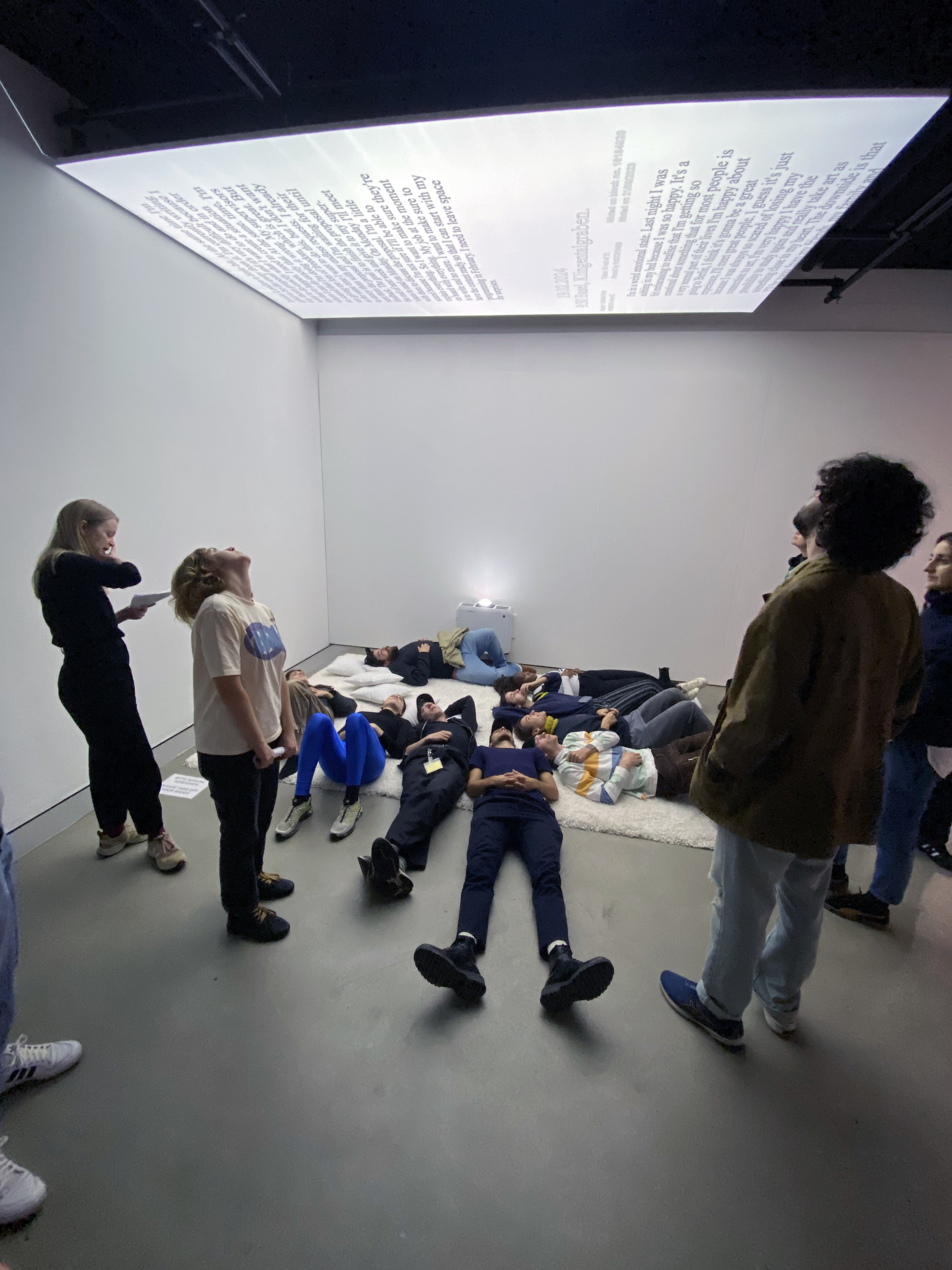 Visit at the HeK, exhibition Exploring the Decentralized Web.
October, 29 07 — Permacomputing (D1.02)
↗ PAD for today Review of previous class + debate (20 min) Lecture: From Switzerland to California and back to the local Screening: “All Watched Over by Machines of Loving Grace. The Use and Abuse of Vegetational Concepts” by Adam Curtis, 2011 Reading: "Permacomputing Aesthetics: Potential and Limits of Constraints in Computational Art, Design and Culture", 2023. Open discussion about today's topic Artworks _ DINOVATION and Nicolas Nova - A bestiary of the Anthropocene, 2021.LINK _ solar.lowtechmagazine.com. LINK _ Wild Project, publishing house. LINK _ Benjamin Gaulon -The Internet of Dead Things Institute, 2018. LINK _ 100Rabbits - Dotgrid, software. LINK _ The Screenless Office. LINK _ Michal Klodner - Livinglab. LINK _ Schpensa - collectif Arvae. LINK + to be defined by the students Writings _ Fred Turner, From Counterculture to Cyberculture: Stewart Brand, the Whole Earth Network and the Rise of Digital Utopianism, 2006. www.are.na/block/939569 _ Stewart Brand, The Whole Earth Catalog, 1968. monoskop.org/images/0/09/Brand_Stewart_Whole_Earth_Catalog_Fall_1968.pdf _ Amanda Starling Gould, Digital Environmental Metabolisms: An Ecocritical Project of the Digital Environmental Humanities, 2017. _ Kent Beck, Programming as a garden: Permaprogramming (talk). _ Aymeric Mansoux and all, Permacomputing Aesthetics: Potential and Limits of Constraints in Computational Art, Design and Culture, 2023 _ FIBER Reassemble Lab: A Future of Internets, (talks). piped.video/watch?v=OOppK1or6RY&t=3036s _ https://permacomputing.net/
November, 5 08 — Self Study
*no room available due to CoCreate workshops* This day is dedicated to preparing your presentations.
November, 12 09 — Quantum Computing (Hek)
Visit of the exhibition "Quantum Visions" at Hek. Meeting at 13:00 inside the museum! More soon...
November, 19 10 — Open Topics
↗ PAD for today Presentation 01: 20 minutes - Marco Antonio Presentation 02: 20 minutes - Tzuchi — break Presentation 03: 20 minutes - Uliana Presentation 04: 20 minutes - Ivan 01 - Whatsapp stickers: a universe where users thrive over corporate designers (from the perspecitve of a designer) Whatsapp is a global platform that touches every continent and over a billion users, and where billions of stickers are sent daily. This presentaiton examines how a small still or animated form of graphicon has gripped certain corners of the world and their visual impact on daily communication. Interestingly, it's a where the lo-fi aesthetic reigns over glossy, polished designs. 02 - Mobile devices' gaming history and its Advertisement Modern mobile games increasingly prioritize monetization mechanics over meaningful gameplay, shifting the player’s role from an engaged participant to a targeted consumer. 03 - Women in Cinema This presentation examines how women directors and writers challenge traditional tropes and reshape the representation of bodies, desire, and power in contemporary film. Through case studies and visual analysis, it highlights how female authorship transforms both narrative structure and cinematic language. 04 - Digital Listening In "Digital Listening", I aim to show how the digital process of sound recording has transformed several fields and how the concept of listening has become more relevant. I will discuss the benefits and disadvantages to help understand the diverse contexts in which digital listening and its "application" are involved.
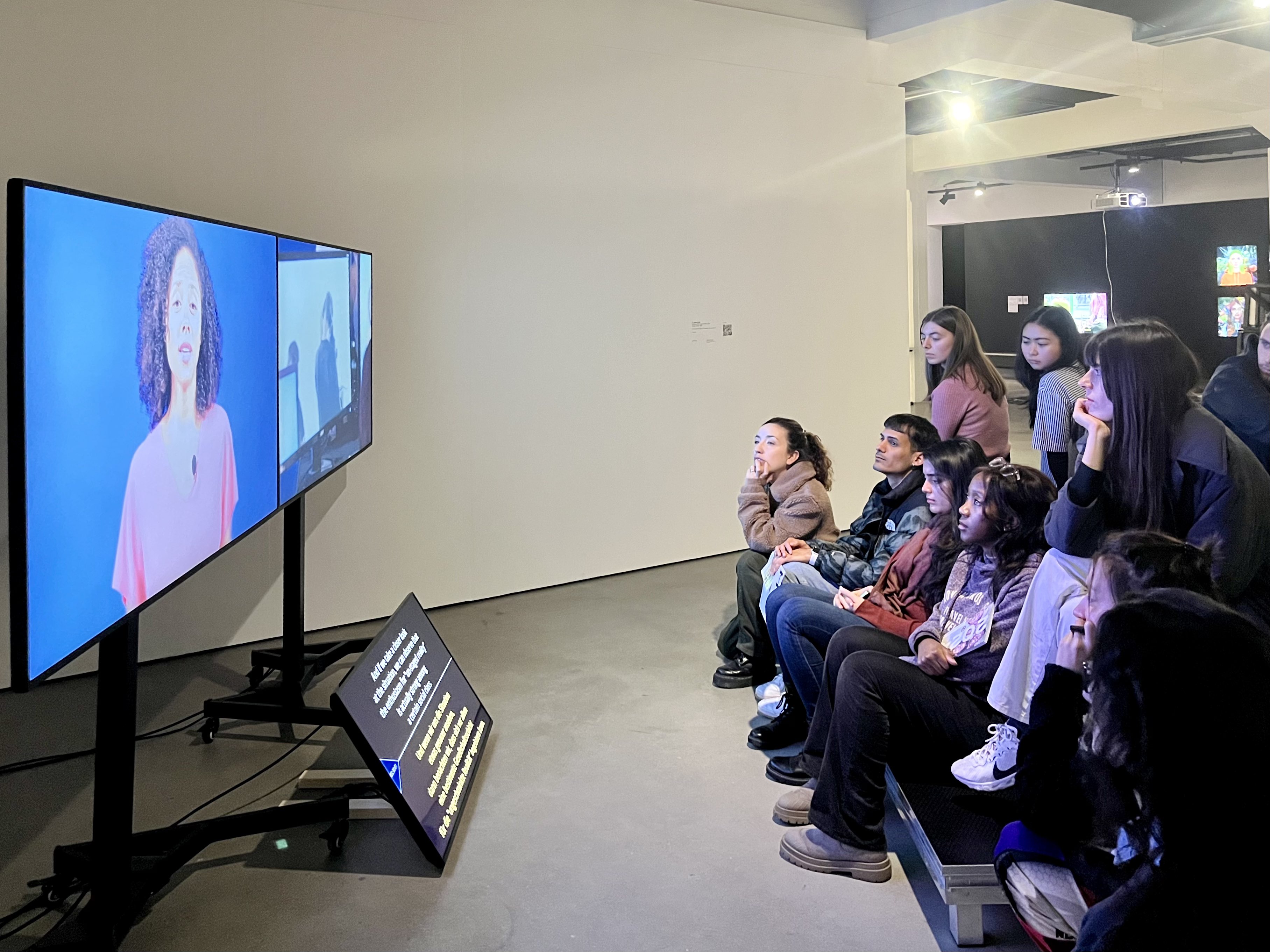 Visit at the HeK, exhibition Indistinct Realities.
November, 26 11 — Open Topics
↗ PAD for today Presentation 05: 20 minutes - René Presentation 06: 20 minutes - Angie — break Presentation 07: 20 minutes - Famo Presentation 08: 20 minutes - Jiawen 01 - Subliminal Stimuli in Communcation and Design This lecture introduces how subliminal stimuli are used in communication and design. We trace key historical moments from early claims in the 1940s and 1950s to contemporary research on their effectiveness. Using examples from film, pop culture, and branding the session shows how subtle visual cues shape perception. We also look at modern applications such as color experiments in digital design and have a look at regulatory frameworks in Europe and Switzerland. The lecture closes with an examination of the ethical implications of subliminal design, including political cases like the “RATS” controversy, encouraging students to reflect on responsibility in visual communication. 02 - Independent Games and Digital Platforms A look at how “independent” creation is reshaped by digital platforms, using Stardew Valley as a case study. The talk explores how visibility, community labor, and participatory cultures redefine independence in contemporary digital environments. 03 - Self-portrait in digital communication environments -How our face and identity are changing in the digital age Description pending. 04 - The power of invisibility Steganography is an old but powerful way of hiding messages, offering a subtle and even poetic mode of communication. I will introduce several forms of steganography, explain their different purposes, and discuss the importance of being tactically invisible in today’s communication environment.
December, 3 12 — Open Topic
↗ PAD for today Presentation 09: 20 minutes - Jules Presentation 10: 20 minutes - Son — break Presentation 11: 20 minutes - Veronica Presentation 12: 20 minutes - Luca 01 - Archiving the Design Archive – Digitisation, Preservation, and Access. Examining how digital technologies have shaped our interactions with libraries and archives and how the shift towards digitisation impacts our understanding of accessible knowledge within the image based archive. 02 - Automated creation: AI in contemporary entertainment This presentation examines how AI is transforming the production of images, voices, and narratives in contemporary entertainment. It focuses on the tension between technological automation and human creativity. It questions the place of human presence in a culture increasingly produced by AI. 03 - Drawing machines: alternative ways to create images An exploration of the machines that have been used for drawing and how the relationship has changed over the years. The presentation shows different types of machines (before and after computers) and ways to use them to produce visual results. 04 - Vertical mediation: The algorithmic production of the Whole Earth Exploring the shift from the awe-inspiring "Whole Earth" of the counterculture to the "zoomed-in" surveillance of the Google era, asking how the technology used to map our world changes the way we understand it.
December, 10 13 — Open Topic
↗ PAD for today Presentation 13: 20 minutes - Qingyan Presentation 14: 20 minutes - Lucie — break Presentation 15: 20 minutes - Chesa Presentation 16: 20 minutes - Natalie 01 - How Digital Technologies Influence the Development of Panoramic Imagery This project examines the historical development of panoramic images and how it has evolved alongside technological advancements, considering not only changes in the practices of creators but also shifts in how viewers perceive, experience, and interpret visual information. 02 - The Texture of Screens This presentation explores how the material texture of screens influences contemporary digital aesthetics and how the evolution from CRT to OLED reshapes our understanding of visual culture, design language, and digital materiality. 03 - Modern Child Labor – Kid Influencer This presentation explores the rise of kid influencers as a modern form of child labor. It examines how social media is blurring the lines between play and work, between family time, childhood and performance. Creating a world or industry where the rules remain unclear and regulation is limited. 04 - Visual Journalism: A Critical History and the Rise of Data Humanism A critical history of visual journalism, tracing how images have shaped public knowledge from early illustrated news to contemporary data storytelling, highlighting Giorgia Lupi’s call for a new, human-centered approach to visualizing information.
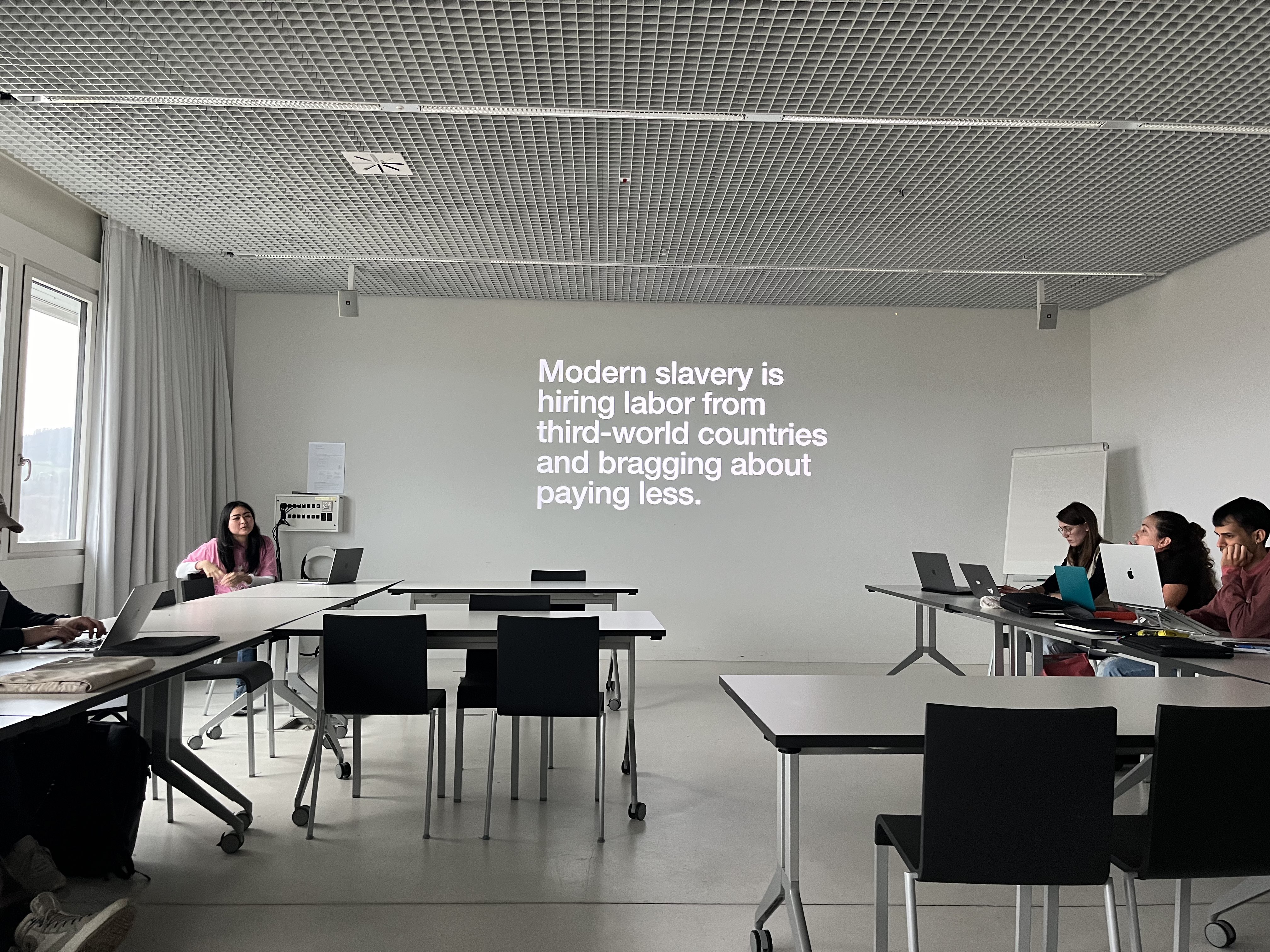 Decolonising (design) Labor, presentation by Catherine.
December, 17 14 — Open topics
↗ PAD for today Presentation 17: 20 minutes - Melina Presentation 18: 20 minutes - Tongtong — break Presentation 19: 20 minutes - Sono Presentation 20: 20 minutes - Summer Presentation 21: 20 minutes - Jun 01 - Democracy in the Digital Age: The Cambridge Analytica Scandal This presentation examines how personal data are used to influence behaviour in the digital age. Starting from the Cambridge Analytica scandal, it follows the evolution of political microtargeting through AI and algorithmic personalisation, and traces its origins in commercial advertising. Selected artistic works highlight how these same technologies reshape not only politics and markets, but also culture and the public sphere. 02 - Theatre of Objects: Sing, Arranging, Reframing the Everyday When artists are no longer focused on creating new media or new artistic forms, they begin to look at existing objects instead. The question becomes how everyday objects can be used to go beyond the everyday. “Theatre of Objects” takes this approach as a practical way of working with daily things, positioning it as a practice that resists consumer culture and the logic of digitalization. 03 - The Television Wars: Media Connections Across the Chinese World. Who Shapes How Chinese Audiences See the World? This talk examines how, from the 1980s to early 2000s, Mainland China, Hong Kong, and Taiwan built a shared yet contested “Greater Chinese” television sphere. It traces how capital, state power, cross-border technologies, and media entrepreneurs shaped what Chinese audiences saw—through STAR & Phoenix TV, Murdoch–Liu ties, Hong Kong/Taiwan tape flows, TVBS talk shows, and CCTV–CNN collaborations—anticipating today’s algorithmic media wars. 04 - Frutiger Aero Frutiger Aero materializes a technologically optimistic imaginary in digital interface design. It communicates a promised future of progress and harmony, one that would later be destabilized by shifts in platform power and design ideology. 05 - Aging the Digital: Giving Decay to a Medium That Cannot Age Digital files don’t really age, they just stay the same until they suddenly break or disappear. This looks at what “aging” might mean in the digital world, and how imagining digital decay can open new ways to think about time in our media.